Standard Chartered connects ASEAN corporates to growth opportunities
Trang Nguyen
June 14, 2019 | 08:09 AM GMT+7
Mid-corporate businesses will have a more critical role to play in enabling future growth of the region in the coming years, through transforming global supply chains and driving regionalised business models.
ASEAN now stands to potentially benefit from the diverted demand
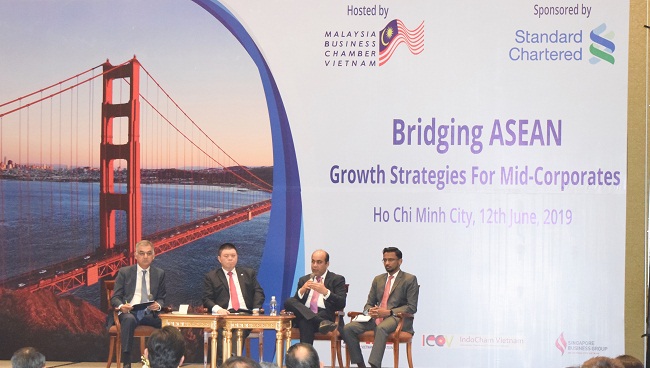
At the seminar entitled ‘Growth Strategies for Mid-corporates’ held by Standard Chartered Bank in collaboration with the Malaysia Business Chamber in Vietnam yesterday, Standard Chartered economist for Asia Chidu Narayanan noted that ASEAN now stands to potentially benefit from the diverted demand arriving from persistent uncertainty around global trade negotiations.
Jiten Arora, global head of Commercial Banking at Standard Chartered, stressed that mid-corporate businesses will now play a more critical role in enabling future growth in the coming years, through transforming global supply chains and driving regionalised business models.
Through its findings in the report named ‘ASEAN – a region facing disruption: positioning mid-corporates for growth in Southeast Asia’, the London-based bank pointed out the strategies that ASEAN mid-corporates need to devise to build growth against major shifts in their respective sectors of operation. These strategies vary from digitalisation to partnerships and overseas ventures, to build growth against major shifts in their respective sectors of operation.
“Adopting digital solutions across the value chain and embracing regional expansion are two key growth themes which mid-corporates should focus on to ensure sustainable growth,” said Arora.
The ASEAN economy is projected to reach $4 trillion by 2023 and become the world’s fourth largest economy by 2030. However, internal and external challenges can impact the region’s competitiveness and long-term growth.
To increase the probability of success against challenges such as low labour productivity (65 per cent lower than global average) and high dependence on external trade (77 per cent of ASEAN exports of goods), mid-corporates in these sectors in ASEAN, including Vietnam, must adopt three key growth strategies of smart operations, digital go-to-market and cross border expansion.
In particular, new technologies including Industrial IoT, 3D Printing and Blockchain-enabled Contracts can improve productivity at the factory floor, optimise supply chain, and enable more efficient project execution.
Solutions including Micro-segmentation, Geo-targeting, and Augmented Reality, meanwhile, can make touchpoints across the customer journey more targeted and personalised.
New sourcing avenues, delivery of products to new market segments, and entering partnerships can strengthen business growth.
These strategies are believed to help mature mid-corporates with an established local presence in Vietnam expand to new regional markets to trigger their next phase of growth.
“ASEAN remains a positive growth story, but the extent of this depends on the adoption of new growth strategies by the private sector, sustenance of policy reforms by national governments and a renewed focus on infrastructure investments,” noted Nirukt Sapru, CEO Vietnam, ASEAN and South Asia Cluster Markets at Standard Chartered Bank. “The private sector, as such, will play a major role in driving ASEAN’s growth.”
“As the country is highly open to trade, Vietnamese mid-corporate manufacturers can capitalise on this and shield themselves from headwinds by pursuing strategies, such as investing in technologies and exploring new markets, which will help them move up the value chain. In fact, we are seeing an increasing number of local electronics players expressing interest to venture overseas for growth,” Sapru said.
Menas Group is spearheading a series of training and human resource development partnerships to support its aggressive expansion into the retail and service sectors.
The story of BEST Express reflects a shift in the logistics industry toward building operational platforms grounded in technology, data, and partner ecosystems.
At 25, Tuan Le is running a profitable short-form video startup, expanding into international markets and setting his sights on building a billion-dollar business in digital marketing.