Ministry's initiative: to make cars not yet manufactured in regional market
June 23, 2017 | 12:02 PM GMT+7
The Ministry of Industry and Trade (MOIT) has proposed an original idea – manufacturing car models that other regional production bases do not make.
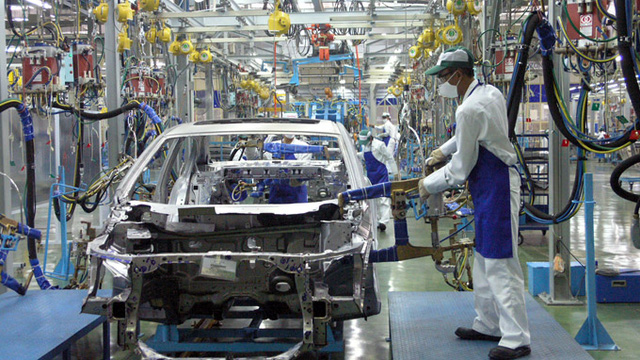
In Vietnam, cars remain expensive. Photo: Internet
Despite the failure of the auto industry development plan in the last two decades, MOIT is still proposing solutions to develop the auto industry.
In the latest move, the ministry has submitted three solutions. It believes that by 2020, the market scale, consumption and production capacity in Vietnam would surpass the Philippines, which has the fourth largest automobile manufacturing in ASEAN.
The first solution, according to MOIT, is that Vietnam needs to create a market large enough to encourage the use of domestically made products.
Second, MOIT programs very strongly support domestic assembly enterprises. If the investment incentives are approved, auto manufacturers will not bear tax on value to be created domestically.
This would be unprecedented preferences offered to auto manufacturers and support enterprises. The third solution, which is the most special, is that Vietnam would attract investments from multi-national groups into large-scale projects in Vietnam.
The projects would focus on making car models which still don’t have production bases in ASEAN.
However, an analyst warned that from 2018, when Vietnam implements its commitments to remove the tariff on CBU and car part imports from ASEAN countries, it would find it difficult to call for new investments into auto projects because it is at a disadvantage.
Vietnam would be inferior to other countries in market consumption; policy stability & fair competition; and car part suppliers, an important factor for product localization.
Consumption remains weak though the consumption growth rate in 2016 was the second fastest in the world. Vietnam consumed 220,000 cars per annum, while the figure is 740,000 in Thailand and 1 million in Singapore.
Meanwhile, the high taxes and fees (which account for 30-60 percent of car value), traffic jams, tolls and environmental protection taxes all have become an obsession for car owners. This is another reason that may discourage investors.
MOIT wants to set up a policy that encourages investments from large corporations from Russia and East European countries, Italy and France, which don’t have joint ventures and production bases in ASEAN.
However, the analyst said Russian cars are not warmly welcomed in Vietnam, while French cars are believed to be too expensive.
The partnership aims to expand the system of charging and battery swapping stations, providing Grab driver-partners and other EV users with easy access to flexible and reliable charging solutions.
Michelin is undergoing a strong transformation by applying AI and smart analytic, helping lead the smart, safe, and sustainable mobility revolution in the Industry 4.0 era.
LG Innotek Vietnam Hai Phong secured a $200 million IFC loan as revenue slows, aiming to expand camera module production while meeting sustainability targets.
For Koen Soenens, Sales and Marketing Director at DEEP C, empathy is a compass that guides major deals, the way a leader builds a team, and the ambition to create a sustainable industrial zone that carries a Vietnamese identity.







![[Hỏi đáp] Hộ kinh doanh khai thuế theo tháng, quý hay năm theo dự thảo nghị định mới?](https://t.ex-cdn.com/theleader.vn/192w/files/content/2025/12/18/164220vha_5034-1641.jpg)
![[Hỏi đáp] Tạm ngừng kinh doanh, hộ kinh doanh có phải kê khai thuế?](https://t.ex-cdn.com/theleader.vn/192w/files/content/2025/12/18/163704vha_7531-1636.jpg)

